The 2025 Texas Teacher Poll: Craft, Care, and A Call to Action


The sixth annual poll of Texas public school teachers, produced by Langer Research Associates for the Charles Butt Foundation, offers an in-depth exploration of teacher preparation and support. It finds that fewer than half of Texas teachers, 48 percent, feel they were prepared to enter the classroom at the start of their careers. The report includes detailed coverage of responses to an open-ended question asking teachers to describe the experiences or trainings that could have helped them be better prepared.

The poll also explores retention and recruitment strategies, teacher pay, ways administrators can create a positive work environment and teachers’ preferred time use, among other topics. Access the full report, topline and methodology here.

A Pilot Test of AI Coding of Open-Ended Survey Responses


This white paper details results of a pilot test using artificial intelligence to code open-ended survey responses into quantitative categories. Our aim was to see if our use of AI could simplify the time-consuming task of coding open-ends without sacrificing data quality.

Compared with human coding, we encountered poor category creation, misclassification and an inability to detect nuance or valence. While our investigation was limited in scope, results suggest the need for caution in using AI for open-end coding when data quality is a priority.

Further advances and additional testing may produce better results. We continue to monitor and test this and other potential applications of AI in our research practice.


Communication and Motivation Strategies


Our research partners often ask us not simply to measure public attitudes or consumer behavior but also to identify their underlying motivations. Those insights, in turn, inform strategies to communicate effectively with groups and encourage their action.

Successful communication and motivation strategies require not only strong data and analysis, but also an understanding of underlying theories developed by academic researchers over the decades. Our work builds actionable results on the foundation of that accumulated knowledge. This white paper describes the conceptual bases for our communication and motivation work.

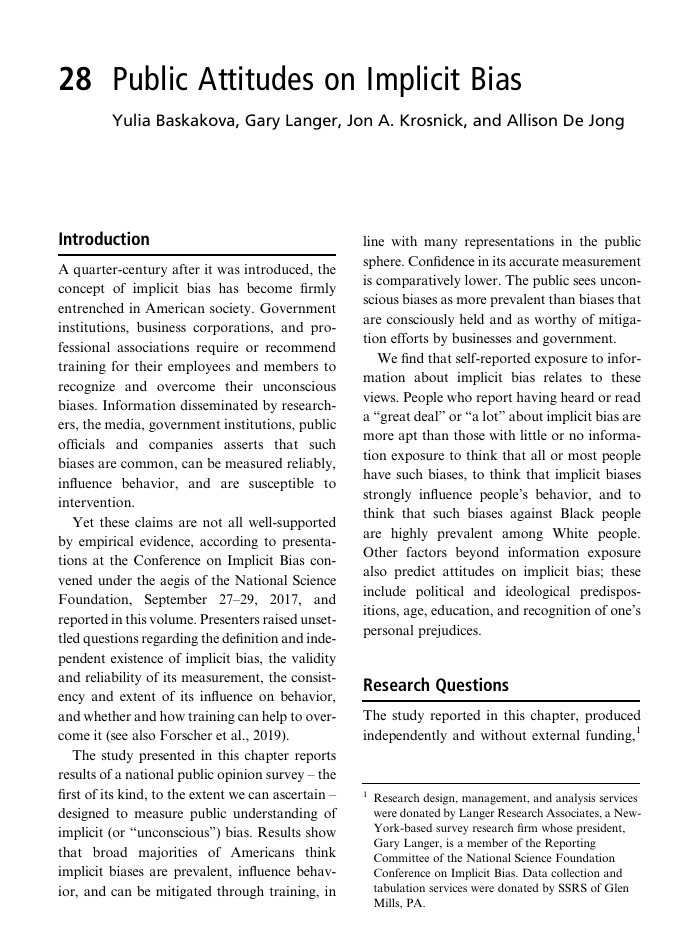
Public Attitudes on Implicit Bias


Cambridge University Press has published The Cambridge Handbook of Implicit Bias and Racism, including a chapter, “Public Attitudes on Implicit Bias,” by Yulia Baskakova, Gary Langer and Allison De Jong of Langer Research Associates and Prof. Jon Krosnick of Stanford University. The chapter, reporting on a representative, probability-based national survey, as well as a review of public claims and policies on the topic, finds “significant disconnects between the state of the science, public pronouncements, and the public’s understanding of implicit bias.” We identify widespread claims in the public realm that implicit bias can be measured reliably, influences behavior and can be mitigated through training, and substantial public acceptance of these claims – all matters on which the scientific evidence is inconclusive.

The survey data and other materials relating to the chapter are publicly available at https://bias-study.parc.us.com. We’re grateful to SSRS for donating data collection services.

Americans’ Views on Book Restrictions in U.S. Public Schools


We partnered with the Knight Foundation to produce an in-depth study of Americans’ views of book restrictions in U.S. public schools. The study fills a critical information gap in the national conversation about book restrictions by providing rigorous, non-partisan analysis of a nationally representative, probability sample survey of more than 4,500 U.S. adults, including 1,138 parents of children in grades pre-K to 12.

The poll finds that two-thirds of Americans broadly oppose efforts to restrict books in public schools and 78 percent have confidence in their community’s public schools to select appropriate books for students. Despite general opposition to book restrictions, six in 10 see age appropriateness as a legitimate reason to limit access to certain materials.

Weight Stigma and Media: Assessing the Impact


A national survey for the Media Empathy Foundation finds that Americans with higher body weight broadly perceive negative stereotypes, body shaming, weight-blaming and exclusion from leading roles in media portrayals of people with higher body weight.

One in three feels personally disrespected by portrayals on TV shows or movies at times, as many feel negative impacts on their self-esteem – and one in four reports negative mental health consequences overall.

We’re proud to have partnered with the foundation on this groundbreaking survey, produced among a representative national sample of more than 1,200 people with higher body weight, with the support of Novo Nordisk Inc. See the full report here.

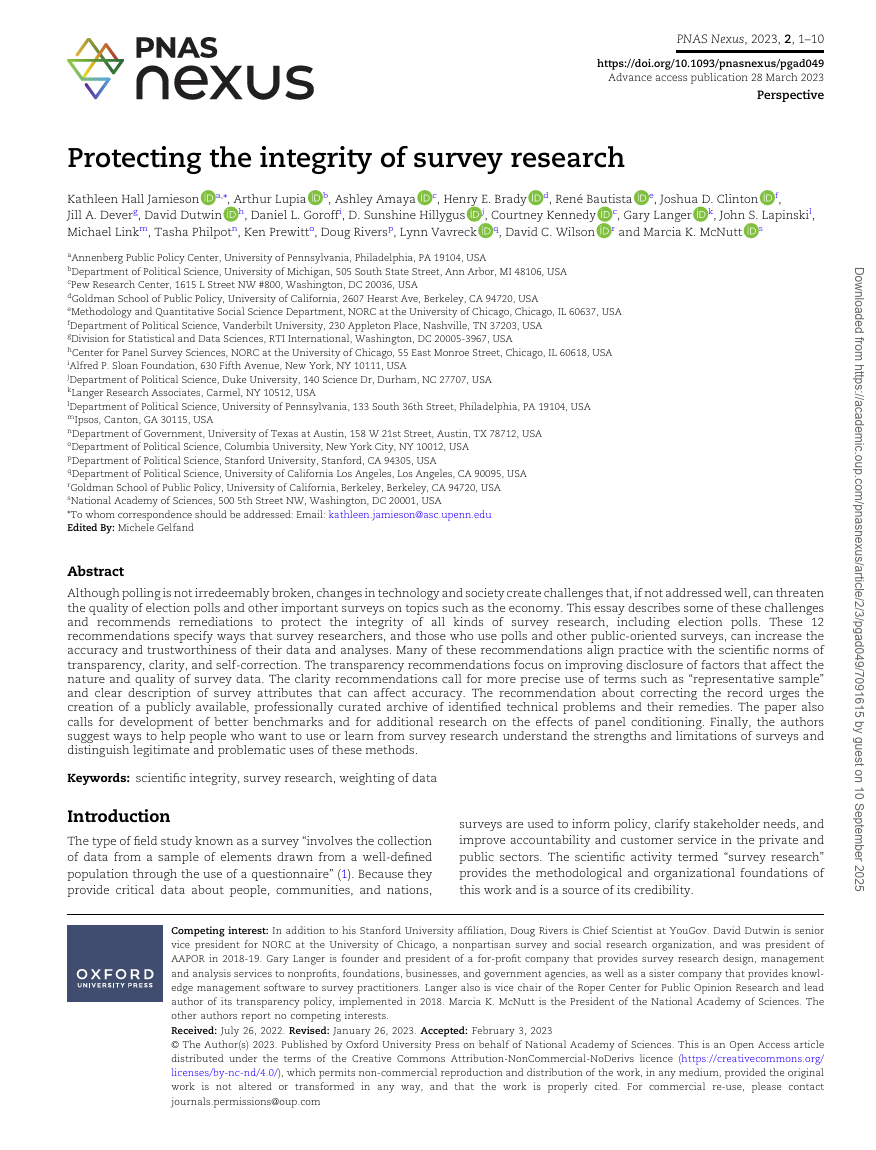
Protecting the Integrity of Survey Research


We’re proud to be associated with this published article in the scientific journal PNAS Nexus, the second journal of the National Academies of Sciences, which suggests 12 steps to improve the integrity, utility and understanding of public opinion surveys, centered around three themes: transparency, clarity and correcting the record.

In sum, the paper calls on survey researchers to be transparent in describing their work, so the research community can independently assess their methods and claims; to be clear and precise in describing their work, including its limitations; and to be willing to issue clarifications and corrections as needed. It encourages all those involved in the survey enterprise – including practitioners, scholars, survey vendors, leaders of professional associations, journal editors, reporters and publishers – to adopt and promulgate these scientific norms.


The 2022 Texas Teacher Forum: Persistent Problems and a Path Forward


Twenty-six Texas public school teachers participated in five days of moderated discussion in online forums conducted by Langer Research Associates for the Charles Butt Foundation, including 14 who were certified traditionally, in undergraduate and graduate programs, and a separate group of 12 with alternative certifications. Their comments add color and depth to the results of the 2022 Texas Teacher Poll — a separate, representative, random-sample survey of Texas teachers also produced for the Foundation.

Among key takeaways, several participants were on the verge of leaving the profession, echoing results from the 2022 statewide survey. The presence or lack of administrative support emerges as a key variable in teacher retention. Comments make clear that proactive campus administrators can put in place effective teacher support systems that encourage retention. See the full report here.

COVID Collaborative Survey: Coronavirus Vaccination Hesitancy in the Black and Latinx Communities


Surveys have documented disproportionate disinclination among Black people in the United States to be vaccinated against the novel coronavirus – a cause of substantial concern for public health professionals given the Black population’s high rates of infection, hospitalization and death from COVID-19. This study, produced and analyzed by Langer Research Associates for the COVID Collaborative, delves deeply into these compunctions, relying on an unusually large, random national sample of Black Americans, a review of the literature on vaccine uptake and consultation with experts in the field.

Conducted among a random national sample of 1,050 Black adults, with a sample of 258 Latinx adults for comparison, the study is being used to help inform a $50 million vaccine education campaign directed by the Ad Council with the participation of the NAACP and UnidosUS. See the executive summary here and full report here.

Learning in the 21st Century: How the American Public, Parents, and Teachers View Students’ Potential and Their Learning Experience


Digital Promise, an education innovation nonprofit, released its first national opinion poll covering student potential and achievement, learner variability, tailored approaches to learning, the use of educational technology and what teachers rely on to do their work.

The report explores differences and commonalities among public school parents, teachers and the public at large on these topics, among others. Among key findings, at least three-quarters of public school parents, teachers and the American public alike believe most students are capable of reaching high levels of educational achievement – but only 19 to 29 percent say most students are reaching those levels today.

Survey production and analysis was conducted by Langer Research Associates, with the report produced by Digital Promise’s Learner Variability Project.