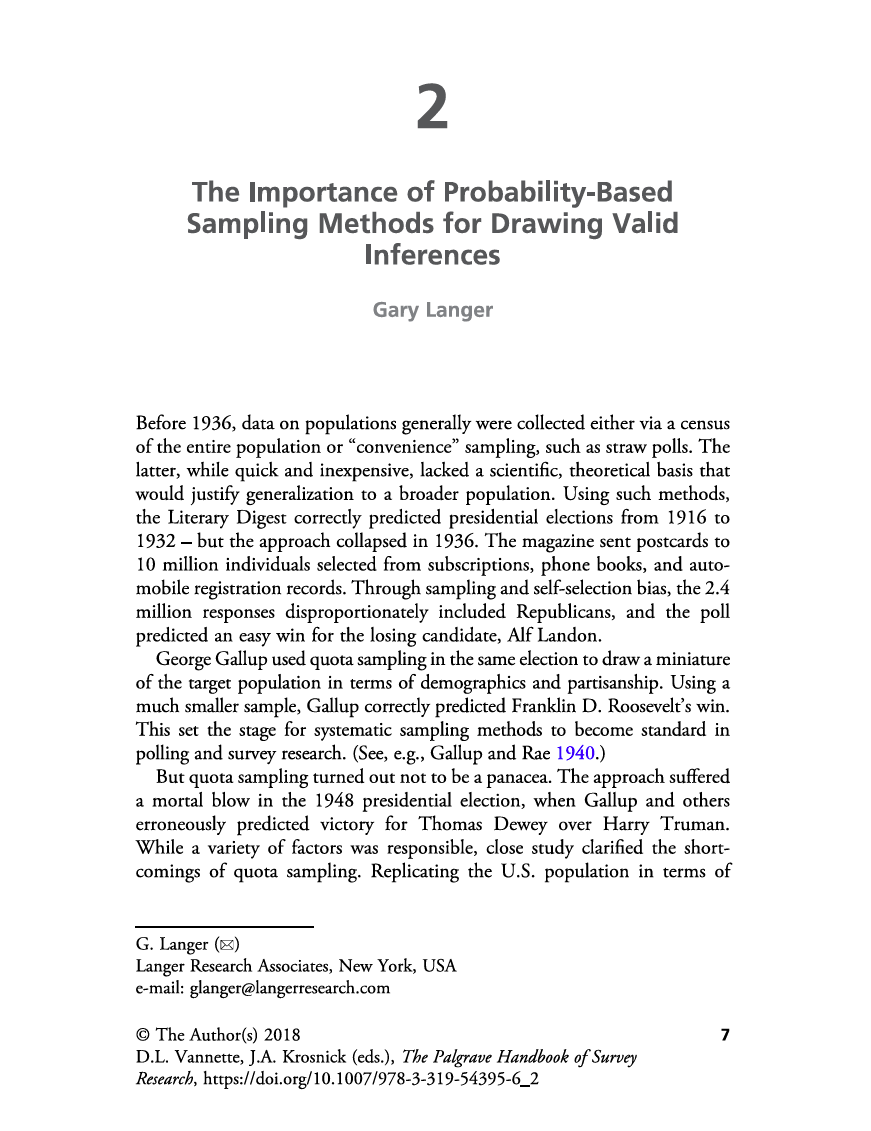
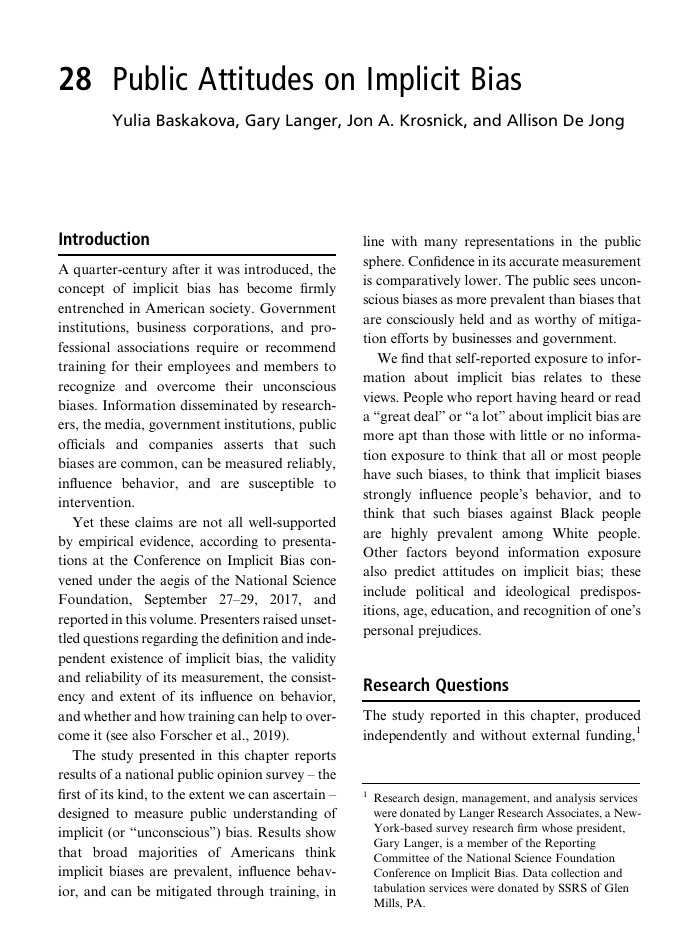
 Cambridge University Press has published The Cambridge Handbook of Implicit Bias and Racism, including a chapter, “Public Attitudes on Implicit Bias,” by Yulia Baskakova, Gary Langer and Allison De Jong of Langer Research Associates and Prof. Jon Krosnick of Stanford University. The chapter, reporting on a representative, probability-based national survey, as well as a review of public claims and policies on the topic, finds “significant disconnects between the state of the science, public pronouncements, and the public’s understanding of implicit bias.” We identify widespread claims in the public realm that implicit bias can be measured reliably, influences behavior and can be mitigated through training, and substantial public acceptance of these claims – all matters on which the scientific evidence is inconclusive.
The survey data and other materials relating to the chapter are publicly available at https://bias-study.parc.us.com. We’re grateful to SSRS for donating data collection services.