
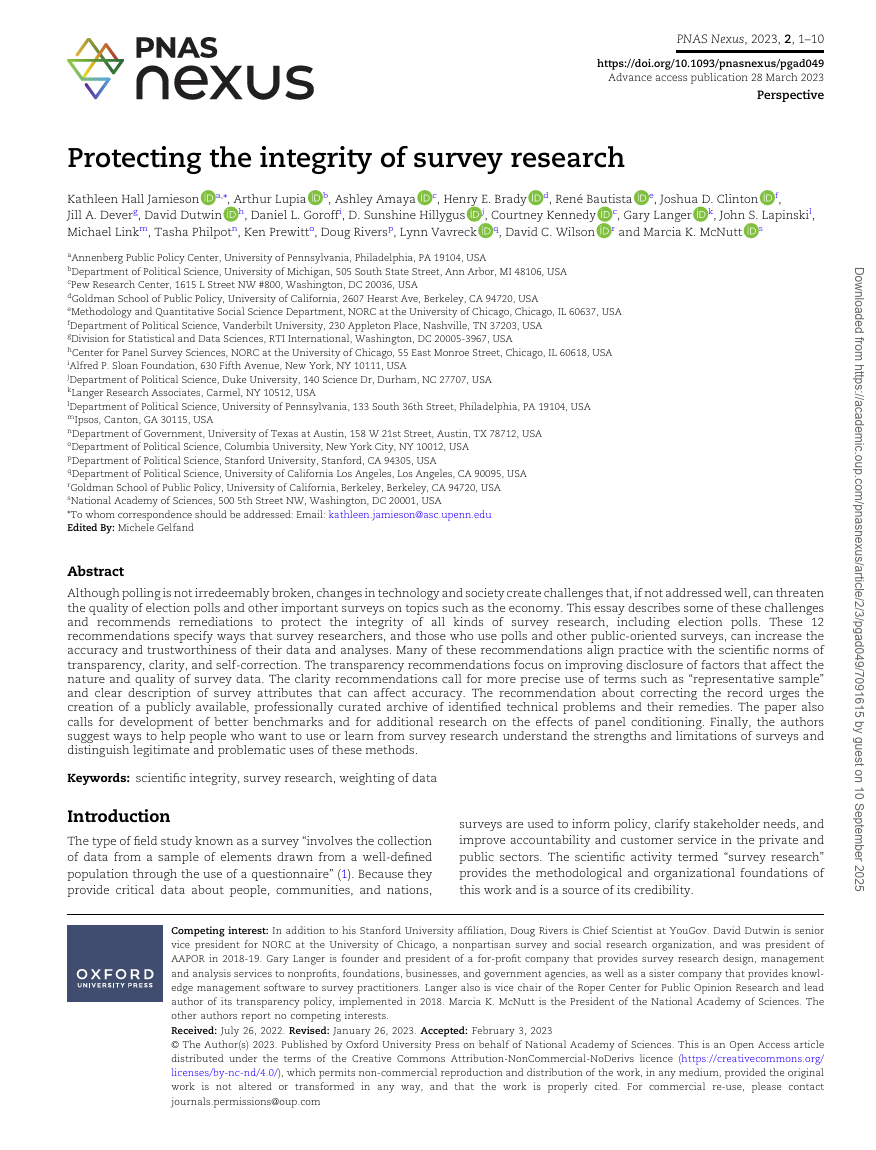
Protecting the Integrity of Survey Research


We’re proud to be associated with this published article in the scientific journal PNAS Nexus, the second journal of the National Academies of Sciences, which suggests 12 steps to improve the integrity, utility and understanding of public opinion surveys, centered around three themes: transparency, clarity and correcting the record.

In sum, the paper calls on survey researchers to be transparent in describing their work, so the research community can independently assess their methods and claims; to be clear and precise in describing their work, including its limitations; and to be willing to issue clarifications and corrections as needed. It encourages all those involved in the survey enterprise – including practitioners, scholars, survey vendors, leaders of professional associations, journal editors, reporters and publishers – to adopt and promulgate these scientific norms.
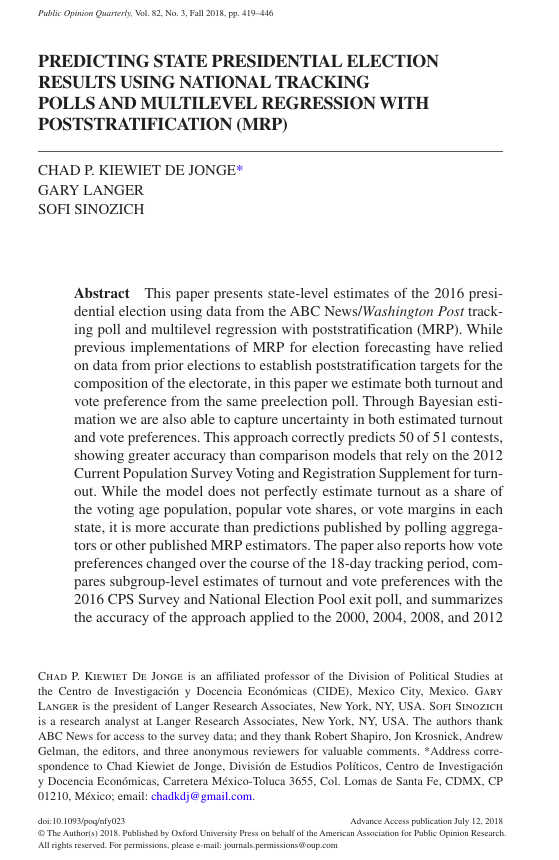
 

Predicting State Presidential Election Results Using National Tracking Polls and Multilevel Regression with Poststratification (MRP)


Our paper, published in Pubic Opinion Quarterly, presents state-level estimates of both turnout and vote preferences in the 2016 presidential election using data from the ABC News/Washington Post tracking poll and multilevel regression with poststratification (MRP). The models, developed over the course of the campaign, successfully predicted the outcome in nearly all states using cumulative data from our ABC News/Washington Post polls.

The paper, co-authored by Chad P Kiewiet de Jonge, Gary Langer and Sofi Sinozich, reports how vote preferences changed over the course of the 18-day tracking period, compares subgroup-level estimates of turnout and vote preferences with the 2016 CPS Survey and National Election Pool exit poll, and summarizes the accuracy of the approach applied to the 2000, 2004, 2008, and 2012 elections. It includes discussion of how researchers can use MRP as an alternative approach to survey weighting as well as in forecasting elections.

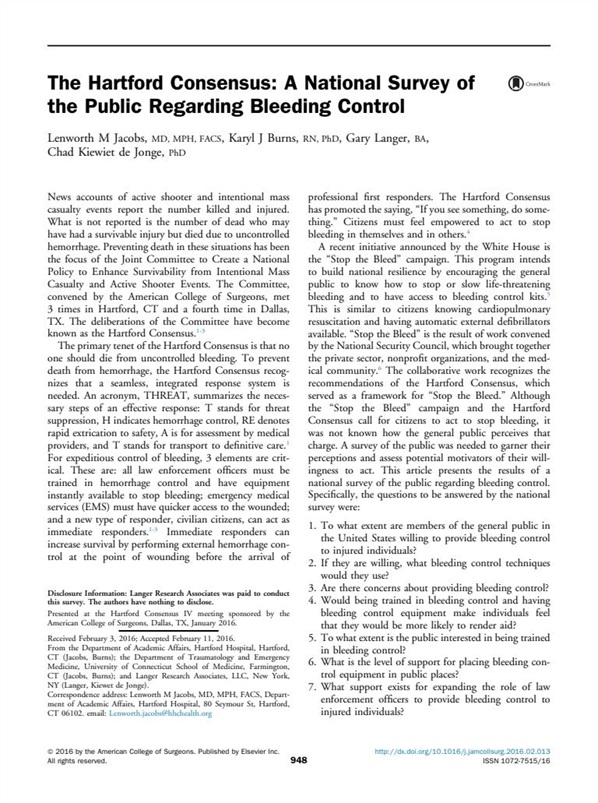
The Hartford Consensus: A National Survey of the Public Regarding Bleeding Control


Americans express broad support for initiatives to train and equip first responders and the public to render first aid for bleeding control in mass casualty incidents. Large majorities also say they personally would be likely to give such aid – especially if training and supplies were available.

There are compunctions: Six in 10 or more cite the risk of causing additional pain or injury, being responsible for a bad outcome or exposure to disease as impediments to aiding trauma victims. Yet for many, the desire to help outweighs these concerns.

These results from a national survey for the Hartford Consensus are published in an article in the Journal of the American College of Surgeons, written by Lenworth M. Jacobs, MD; Karyl J. Burns, RN, Ph.D.; Gary Langer; and Chad Kiewiet de Jonge, Ph.D. Our full report for the Hartford Consensus can be viewed here.